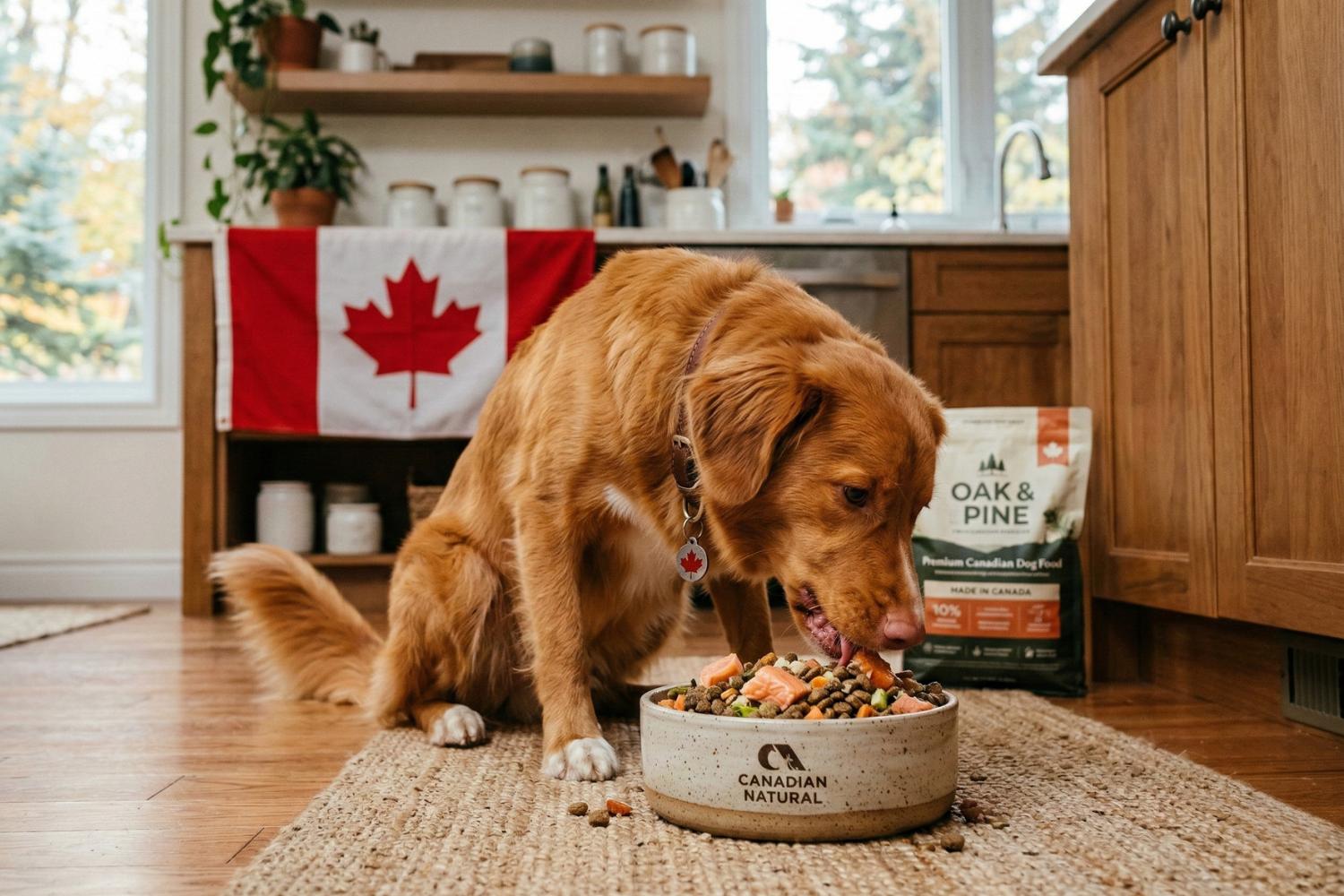
Choosing dog food made in Canada starts with checking where the exact recipe is manufactured. A Canadian brand name, a Canadian retailer and Canadian ingredients are different things. This guide explains how to check manufacturing claims, compare recipes and calculate feeding costs. It also distinguishes foods made in Canada from other options available to Canadian shoppers.
Why choose dog food made in Canada?
Choosing food manufactured in Canada can support Canadian production and may make it easier to contact the manufacturer about a recipe. However, a Canadian brand name does not necessarily mean every product is manufactured in Canada or uses only Canadian ingredients.
Check the packaging and the manufacturer’s information for the exact recipe. Ask where it is made, where its ingredients come from and what quality-control checks the manufacturer performs.
Pet food in Canada is not regulated as comprehensively as human food. The Canadian Food Inspection Agency’s oversight focuses on import and export requirements for animal products and by-products. Canadian manufacture alone is not a guarantee of nutritional suitability or safety.
Dog food brands available to Canadian shoppers
The following brands offer foods available in Canada. Manufacturing locations and ingredients can vary by recipe and product format, so check the exact food you plan to buy.
1. Boréal Dog Food
Boréal offers both grain-free and grain-inclusive dog food recipes. Compare the specific formula’s ingredients, calorie content and stated life stage rather than treating the entire range as one product. Check the manufacturing information for the recipe and format you intend to buy.
2. FirstMate Dog Food
FirstMate offers Grain Free, Grain Friendly and canned formulas. These ranges contain different recipes, so check the exact product label when comparing ingredients and feeding costs. Ask the manufacturer about production location and nutritional suitability for the particular food you are considering.
3. Performatrin Dog Food
Performatrin offers formulas for different life stages, breed sizes and selected dietary needs. Choose by the specific recipe’s nutritional information and intended use. A formula designed for a particular breed size is different from one designed for a named breed; check the label rather than assuming either applies.
4. Freshpet: available in Canada, made in the United States
Freshpet sells refrigerated dog food in Canada, but the company states that its recipes are made in Freshpet-owned kitchens in the United States. It belongs in a comparison of foods available to Canadian shoppers, rather than a list limited to foods manufactured in Canada.
If you are considering Freshpet, check the exact recipe’s nutritional information, feeding directions and refrigeration requirements.
Compare the recipe, not just the country of manufacture
Manufacturing location is one part of choosing dog food. It does not tell you whether a particular recipe suits your dog’s life stage, calorie needs or dietary requirements. Compare the exact products rather than assuming every food from a Canadian brand has the same ingredients or benefits.
Record each recipe’s full name, bag size, price, calorie content and nutritional adequacy statement. Check whether it is intended for growth, adult maintenance or another stated purpose. For a puppy expected to become a large adult dog, ask your veterinarian whether the recipe is suitable for large-breed growth.
Compare feeding costs using the amount your dog needs each day. For example, a hypothetical CAD $80 bag weighing 10 kg costs $8 per kilogram. Feeding 250 g daily would cost $2 per day. These figures demonstrate the calculation; they are not a quoted product price or feeding recommendation. Different recipes can have different calorie densities, so equal portions by weight may not provide equal energy.
If your dog has persistent itching, digestive problems or a diagnosed condition, discuss the food with your veterinarian. Terms such as “natural,” “grain-free” and “limited ingredient” do not establish that a recipe will resolve the problem.
Questions to ask the manufacturer before choosing a food
Start with the exact recipe you are considering. Ask where it is manufactured and whether that location applies to the specific product format, such as dry, canned or refrigerated food. If Canadian ingredients matter to you, ask which ingredients are sourced in Canada rather than assuming the entire recipe is locally sourced.
Ask who formulates the food and what qualifications they hold. Request information about how the company checks nutritional adequacy, tests finished products and manages quality control. A useful answer should explain the process rather than simply describe the food as “premium.”
Check that the packaging provides feeding directions, calorie information, a lot number and contact details. Keep the original packaging so you can identify the product if you need to report a concern. If the manufacturer’s answer is unclear, ask a follow-up question before making your decision.
Choose according to your dog’s needs and the information available about the recipe. An ingredient list or country-of-manufacture claim alone cannot establish whether a food is the right choice.
Transitioning Your Dog to Canadian Dog Food
Switching your dog to a new food should be gradual to prevent digestive upset:
- Start by mixing 25% new food with 75% old food for 3-4 days.
- Gradually increase new food to 50% for the next 3-4 days.
- Move to 75% new food for 3-4 days.
- Fully transition to 100% Canadian dog food after 10-14 days.
Keep useful records when changing foods
Before switching, record the current food’s full recipe name, your dog’s daily portion and why you are considering a change. Keep the new food’s packaging, lot number and best-before date. Follow its storage instructions, including any refrigeration requirements.
During the transition, note how much your dog eats and any changes in stool, appetite or comfort. Avoid changing several foods, treats and supplements at once; that makes it harder to identify which change may be associated with a problem.
If problems develop, contact your veterinarian and provide the product details and timing of the change. Your notes can support that conversation, but they cannot establish a diagnosis.
Final Thoughts
Canadian manufacturing may matter to you, but it is only one part of choosing dog food. Check the exact recipe’s production location, nutritional adequacy statement, calorie content and feeding directions. Ask the manufacturer questions when information is unclear, and compare costs using your dog’s daily portion rather than the bag price alone.
Keep the packaging and introduce dietary changes according to your dog’s needs. If your dog has a medical condition or requires a special diet, ask your veterinarian about the specific recipe before switching.